If you’re comparing healthcare procurement and inventory software for a multi-site organization, Hybrent and Envi are likely on your shortlist. Both are built for healthcare. Both serve ambulatory surgery centers (ASCs), physician groups and critical access hospitals. Both promise better visibility and control over supply spend across locations.
On a feature checklist, they look alike. The differences show up in three places: how ordering feels for the people placing orders, support and service levels after the purchase, and who owns the software and what that means for your contracts.
This guide compares the two side by side, built around the problems procurement directors, supply chain leaders, and CFOs are trying to solve.
The Problem: Fragmented Spend and Inventory Across Locations
If you manage procurement for more than one facility, these symptoms probably sound familiar:
- Each location orders differently, so you can’t get a clean read on spend by category or vendor.
- Clinical staff go around the systems and processes when it’s easier than following it, so off-contract and off-formulary purchases keep showing up.
- Inventory counts live in spreadsheets, on whiteboards, or in someone’s head.
- Invoice reconciliation is manual, so AP is always catching up instead of flagging discrepancies before invoices are paid.
- When leadership asks what you’re spending on a category across all sites, the answer takes a week to pull together.
Any platform worth evaluating should solve these problems directly, not just digitize the existing process.
Hybrent and Envi at a Glance
Hybrent is a procure-to-pay and inventory platform designed for surgery centers, physician offices and clinics, community health centers and FQHCs, dental groups, and community and critical access hospitals.
Envi is built by Inventory Optimization Solutions (IOS), which has focused exclusively on healthcare supply chain. It is a full materials management information system (MMIS) serving acute and non-acute providers, from hospitals to ASCs, physician practices, and long-term care.
What Hybrent and Envi Have in Common
Both platforms cover the core of healthcare procure-to-pay:
- Multi-vendor purchase orders with approval workflows
- EDI, non-EDI, and punchout ordering with distributors and suppliers
- Barcode-based inventory tracking, including lot, serial, and expiration data
- Mobile apps for iOS and Android
- Invoice matching against purchase orders and receipts (three-way match)
- Reporting on spend by location and department
- Integration with accounting and financial systems
If your evaluation stops at the feature list, you’ll likely call it a tie. The differences are in the details below.
Where Hybrent and Envi Differ
1. Where Each Platform Puts Its Depth
Hybrent puts its depth in the buying process, for organizations ranging from surgery centers and clinics to community and critical access hospitals:
- A controlled item master with preferred vendors and formulary items
- Comparison shopping across vendors
- Contract management with item-level costs and pricing tiers
- Invoice processing that sends approved invoices to your accounting system with automated GL coding
Procurement Partners reports about 400 directly integrated suppliers.
Envi is a broad MMIS. Alongside ordering and invoicing, it lists capabilities like implant tracking, consignment tracking, par cart management, patient usage tracking, and a built-in interface engine for connecting financial and clinical systems. That breadth is a real strength for organizations with hospital-style supply chain needs.
2. Ease of Ordering at the Location Level
Both vendors earn solid marks from users.
Envi: On review sites, users frequently praise its support team and the time it saves on ordering. Some reviewers mention a difficult initial setup and “lots of clicks” to complete routine tasks. Envi has also invested in product improvements in recent years.
Hybrent: It’s designed around an online-shopping experience. Staff search across all vendors in one place, add items to a cart, and submit, while approvals and formulary rules apply behind the scenes. Reviewers consistently call it easy to use and say it cuts the time spent on ordering. That matters most when the person placing the order is a nurse, front-desk lead, or office manager rather than a full-time buyer.
3. Spend Control Before the Purchase, Not Just Reporting After
Both platforms report on spend and support approval workflows.
Hybrent pairs its approvals with a controlled item master and formulary. Staff are steered to preferred items and contracted vendors as they shop, and purchases outside the rules can be routed for approval before they’re placed. Reporting includes prebuilt and customizable reports, Excel export, BI tool integration, and cost allocation by patient, department, physician, or project.
4. GPO Ownership and What It Means for Your Contracts
IOS is part of Provista and Vizient, so Envi is closely tied to a major GPO. Envi may be offered at reduced or no cost through that relationship, which can be attractive. It’s also worth asking:
- Whose contracts are loaded and promoted in the system?
- How easily can you use vendors and pricing from other agreements?
- Who has visibility into your purchasing data?
Hybrent is not owned by a GPO. Its contract management is designed to store and enforce the agreements you negotiate, whatever GPO or direct vendor relationships you have. Because it isn’t tied to a GPO ecosystem, you also keep flexibility in your broader tech stack and your vendor choices.
5. Implementation, Training, and Support
Both vendors earn praise for their support teams. What matters is what happens before and after go-live: how implementation is run, how staff are trained, and who you call when something breaks. Ask each vendor:
- Who leads implementation, and how long does it typically take for an organization your size?
- What training is provided for the people placing orders, not just administrators?
- What does ongoing support look like after go-live?
Hybrent implementation typically takes 60 to 90 days, depending on the complexity of your organization. Every customer is assigned an implementation contact and a customer success manager. You work with one point of contact rather than a rotating queue, though that person isn’t exclusively assigned to your account. After go-live, your customer success manager stays involved through regular check-ins and usage reviews. The level of engagement is matched to your organization’s size and needs, so adoption and supplier spend keep growing across your locations.
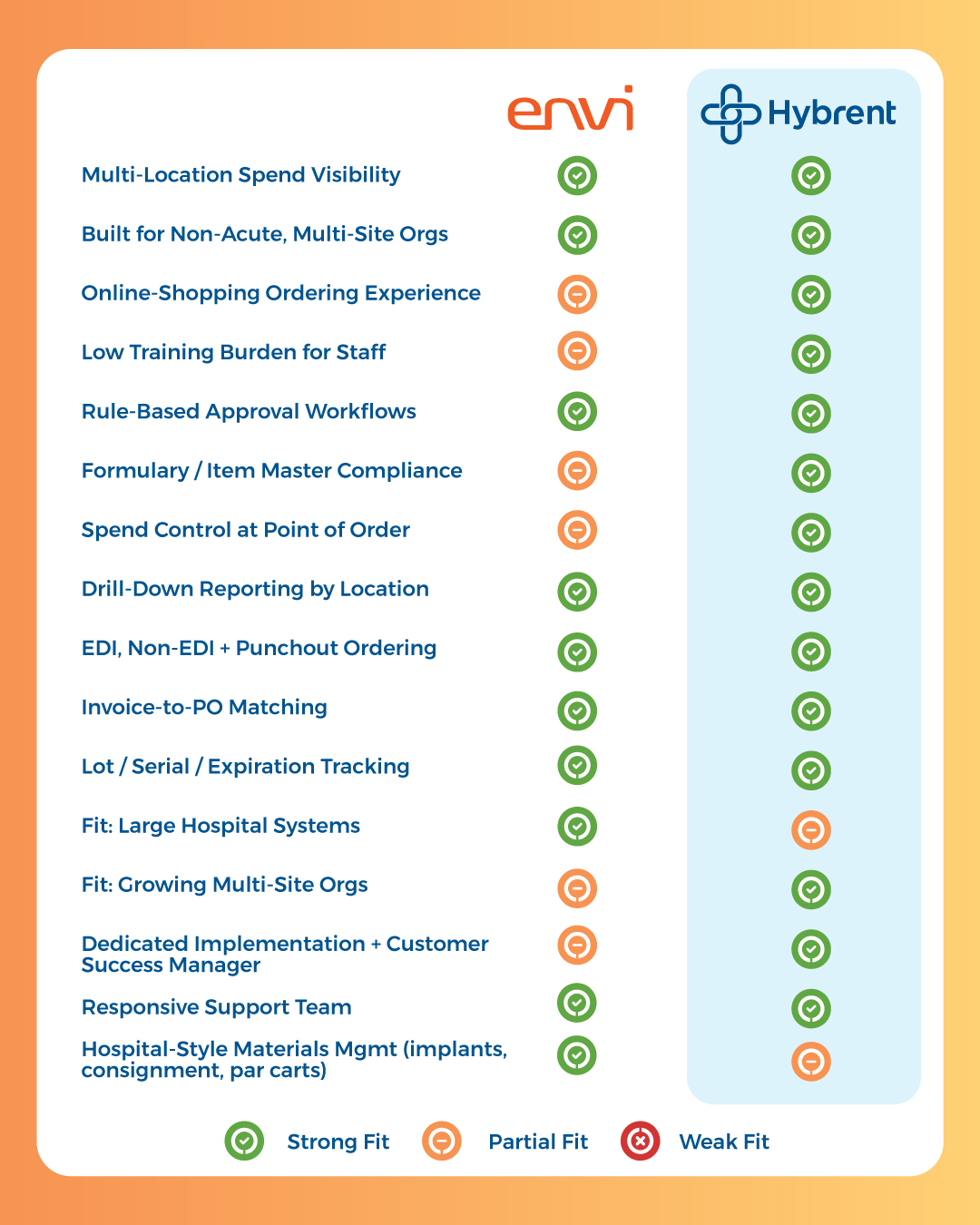
Hybrent vs. Envi: Side-by-Side Comparison
Which Platform Is Right for You?
Choose Envi if you need hospital-style materials management capabilities, or the GPO-affiliated model fits your purchasing strategy. It’s an established, healthcare-focused MMIS with real depth, broad coverage across acute and non-acute settings, and strong support.
Choose Hybrent if you manage procurement and inventory across a growing number of surgery centers, physician offices, or clinics, and your real challenge is:
- Getting consistent adoption
- Enforcing your formulary and contracts at the point of order
- Keeping full control of your vendor relationships
- Implementation, training, and support that keep every location on the same process
Whichever way you lean, ask each vendor for a demo built around your two biggest blockers. Feature lists rarely tell the whole story.
Frequently Asked Questions
What is the main difference between Hybrent and Envi?
Envi is a full MMIS with hospital-style capabilities like implant and consignment tracking, and it is tied to a GPO through its parent company. Hybrent is independent of any GPO and focuses on the procure-to-pay process, with an online-shopping experience, a controlled item master, and contract enforcement.
Is Hybrent owned by a GPO?
No. Hybrent is not owned by a GPO, and its contract management is built to enforce whatever agreements you negotiate.
Do Hybrent and Envi serve the same types of organizations?
Largely, yes. Both serve ASCs, physician groups, and hospitals, including critical access hospitals. The difference is less about who they serve and more about GPO ownership and the service model behind the software.
Next step: Get the healthcare procurement checklist or schedule a demo to see how Hybrent handles multi-location ordering, approvals, and contract compliance for organizations like yours.