Healthcare vendors and suppliers often get lumped together. Purchase orders, contracts, and vendor master files use the two words interchangeably, and in day-to-day conversation that rarely causes a problem.
For companies selling into healthcare, the distinction matters more. A facility will buy from a transactional vendor when it needs to, but it builds its ordering habits around a strategic, preferred supplier. That supplier usually gets steadier volume and longer contracts, and it’s the first one a buyer checks when it’s time to reorder. Ambulatory surgery centers, physician offices, skilled nursing facilities, and senior living communities are all watching margins closely right now, so they’re getting more selective about which suppliers earn that spot.
This post looks at how the two roles differ, where group purchasing organizations come in, and how healthcare procurement software can help a supplier move from the approved list to the preferred one.
Transactional Vendors vs. Strategic, Preferred Suppliers
A transactional vendor sells to a facility when the facility needs something. Someone places an order, the goods arrive, the invoice gets paid, and the relationship more or less resets until the next order. Price and availability on that day usually decide who gets the business.
A strategic, preferred supplier has a standing relationship with the facility. There’s typically a contract with negotiated pricing, agreed product standards, and expectations for fill rates and delivery. Buyers are pointed to that supplier’s products by default, and both sides review performance over time.
Which label applies depends on the relationship with each facility. A national distributor can be the preferred supplier for a multi-site senior living operator under a prime vendor agreement and, at the same time, an occasional vendor for an independent clinic that pays by credit card. Manufacturers, distributors, specialty retailers, and service providers can all land on either side.
Most facilities keep all of these relationships in one vendor master file, usually managed with vendor management software inside their ERP or healthcare supply chain software. That system tracks tax IDs, payment terms, insurance certificates, and contract dates. It rarely shows which relationships are strategic and which are one-off purchases, which is part of why the two terms blur.
What Is a Group Purchasing Organization in Healthcare, and Where Does It Fit?
A group purchasing organization (GPO) in healthcare pools the buying volume of many providers to negotiate pricing and terms with manufacturers and distributors. Members get access to contracts they couldn’t negotiate alone. Suppliers get access to a large member base and the prospect of committed volume.
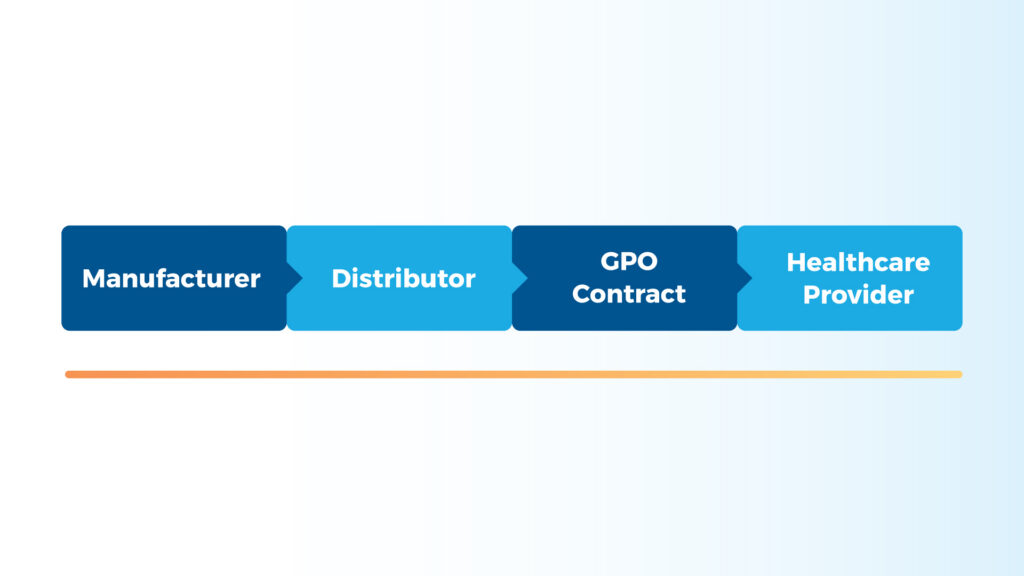
For many companies, a GPO contract is the first step from transactional vendor to strategic supplier. Being on contract usually brings:
- Tiered pricing that rewards members for higher compliance or volume.
- Compliance targets that measure how much of a member’s category spend goes to the contracted supplier.
- Administrative fees paid by suppliers to the GPO, which must be disclosed in a written agreement.
- Reporting obligations, such as sales tracing and rebate reporting, that the GPO and supplier both rely on.
Getting on contract helps, but the contract only pays off when facilities buy at the contracted price. A nurse manager at a skilled nursing facility might order gloves from a retail site because it’s quicker. An ASC might buy implants off contract because the contracted SKU was hard to find. When that happens, the supplier loses volume it was counting on and the GPO’s compliance numbers drop. The facility also ends up paying more than it had to.
Group purchasing organization software and contract management tools can flag that leakage after it happens. Preventing it when the order is placed depends on the procurement tools the provider uses.
How Healthcare Procurement Software Helps Suppliers Earn Preferred Status
Preferred suppliers are rarely chosen on price alone. Buyers come back to the suppliers that are easiest to order from correctly, and a lot of that depends on how well a supplier connects to the provider’s healthcare procurement software.
Punchout catalogs put contract pricing in front of buyers. A punchout catalog lets a buyer jump from the facility’s procurement system into the supplier’s online catalog, shop with contract pricing already applied, and bring the cart back for approval. Most punchout integrations use the cXML standard, which keeps the order, purchase order, and invoice tied together. A supplier punchout catalog connected to a provider’s eprocurement software means buyers see your contracted items at the right price inside the system they already use.
Clean catalog data keeps buyers on contract. Accurate descriptions, units of measure, manufacturer part numbers, and current pricing make your products easy to find and hard to swap out. Incomplete or outdated item data sends buyers elsewhere, often without anyone noticing.
Procure-to-pay software catches pricing errors before payment. When requisitions, approvals, purchase orders, receiving, and invoice matching run in one procure to pay software platform, a price mismatch shows up before the invoice is paid instead of months later in a rebate dispute. Suppliers get paid faster and deal with fewer disputed invoices. GPOs get cleaner data on what members bought.
Spend visibility gives everyone the same numbers. For multi-site providers, centralized purchasing data shows which facilities buy on contract and which don’t. Suppliers and GPOs can then talk with providers about compliance and conversions using shared data instead of comparing three different reports.
From the facility’s side, most of the names in the vendor master get an order now and then. The suppliers that get more of the spend are usually the ones whose catalogs are connected, whose contract pricing shows up when a buyer places an order, and whose invoices match the PO without anyone having to chase down a difference.
Frequently Asked Questions
What is the difference between a vendor and a supplier in healthcare?
In practice, the difference is the relationship. A transactional vendor sells to a facility order by order, usually at list or spot pricing. A strategic, preferred supplier works under a contract with negotiated pricing, performance expectations, and a default spot in the facility’s catalog. The same company can be either one, depending on the facility.
What is a group purchasing organization in healthcare?
A GPO combines the purchasing volume of many healthcare providers to negotiate pricing and terms with manufacturers and distributors. Members get access to contract pricing. Suppliers get access to a large base of buyers in exchange for contracted pricing and administrative fees.
What is a punchout catalog?
A punchout catalog lets buyers open a supplier’s online catalog from inside their own procurement system, shop at their contract pricing, and return the cart to their system for approval and purchase order creation. It keeps purchases on contract and links ordering to invoicing.
How does healthcare procurement software help GPO contract compliance?
It points buyers to contracted items and pricing when they order, routes purchases through approval workflows, and matches invoices against contract pricing. That reduces off-contract spend and gives GPOs and suppliers accurate data on what members are buying.
See How Your Catalog Connects
Procurement Partners connects suppliers and GPOs with ambulatory surgery centers, physician offices, senior living communities, and skilled nursing facilities through the Hybrent and OnCare platforms. Punchout catalogs, contract pricing, and invoice automation are built in.
If you’re a supplier or GPO that wants to keep more volume on contract, see how your catalog connects.