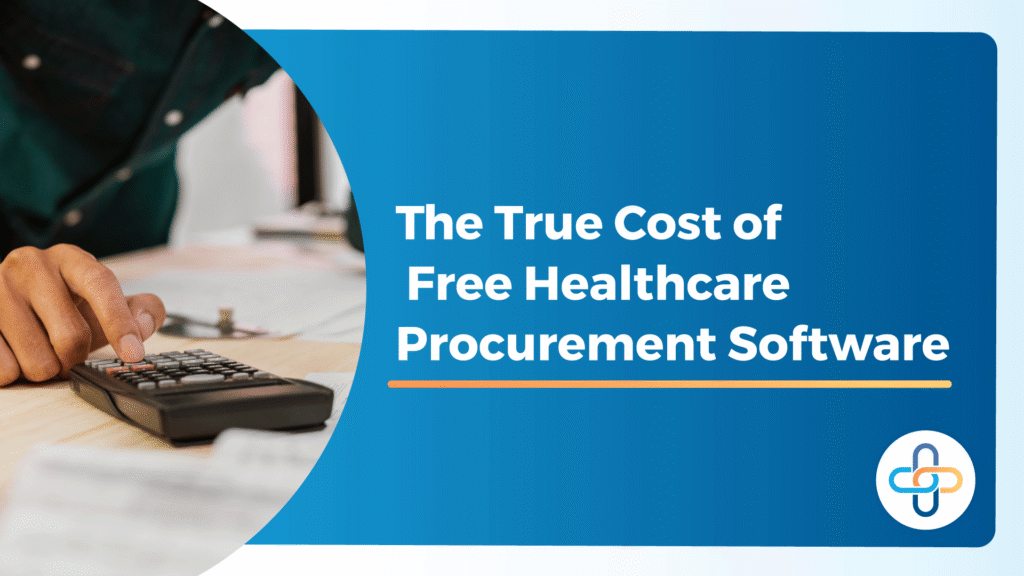
For a skilled nursing facility, an ambulatory surgery center, or a physician group running on tight margins, “free” is a powerful word. When a vendor offers free procure-to-pay software, or when the current system is a mix of spreadsheets, email approvals, and a supplier’s own ordering portal, it can feel like the purchasing problem is already handled at no cost.
But procurement software isn’t a one-time purchase. It’s the system your team uses every day to order supplies, approve spend, receive shipments, and pay invoices. When that system is free, the costs don’t disappear. They move into staff hours, off-contract spending, invoice errors, and decisions made without good data.
Why “Free Procure-to-Pay Software” Ends Up Costing Healthcare Organizations More
Most free or bundled purchasing tools are built for general businesses, or they’re offered by a single supplier to keep orders flowing to that supplier. Neither model is designed around how healthcare organizations buy. That gap shows up in a few predictable places.
Staff time spent working around the system. When a tool doesn’t handle approvals, receiving, and invoice matching in one place, your team fills the gaps by hand. Directors of nursing, administrators, and business office managers end up re-keying orders, chasing approvals over email, and reconciling packing slips against invoices. Those hours rarely appear on a budget line, but they come out of time that should go to residents and patients.
Off-contract and maverick spending. Free tools usually can’t enforce a formulary or show negotiated GPO pricing at the point of order. Without guardrails, staff buy what’s convenient, not what’s on contract. Small price differences on high-volume items like gloves, briefs, and wound care supplies compound quickly across facilities.
Invoice errors and duplicate payments. Without automated three-way matching between the purchase order, receipt, and invoice, pricing discrepancies and duplicate invoices slip through. Every one of those becomes a manual correction, a vendor credit to chase, or money that’s simply lost.
Supplier lock-in. A “free” ordering portal from a distributor is free because it steers purchasing toward that distributor. It’s harder to comparison shop, harder to add secondary vendors, and harder to see whether you’re actually getting the best price.
No visibility for leadership. When spend lives in spreadsheets and vendor portals, finance and operations leaders can’t easily answer basic questions: What did each facility spend on supplies per patient day? Which departments are over budget? Where are we paying more than contract? Decisions get made on incomplete data, or not at all.
Procure-to-Pay Software Pricing vs. Total Cost of Ownership: What the Sticker Price Leaves Out
When organizations compare procure-to-pay software pricing, they often line up subscription fees side by side and stop there. A more useful comparison is total cost of ownership: everything it costs to run purchasing through a given system over a year or more.
Cost area | “Free” tool or manual process | Purpose-built healthcare procurement software |
Subscription fee | $0 or bundled with a supplier | Predictable license cost |
Staff time | High: manual entry, email approvals, paper receiving | Lower: automated approvals, mobile receiving, auto-matching |
Contract compliance | Hard to enforce; off-contract buying is common | Formularies and GPO pricing applied at the point of order |
Invoice accuracy | Manual matching; errors and duplicates slip through | Automated three-way match flags discrepancies |
Vendor choice | Often limited to one supplier | Comparison shopping across a vendor network |
Reporting | Spreadsheets pulled together by hand | Real-time spend data by facility, department, and category |
Integrations | Few or none | Connects to accounting and EHR systems |
A simple way to estimate your own numbers:
- Count the hours. Estimate how much time each facility spends each week placing orders, chasing approvals, receiving, and reconciling invoices. Multiply by a loaded hourly rate.
- Measure off-contract spend. Pull a sample of recent invoices and check how many items were bought at above-contract pricing.
- Track invoice exceptions. Count how many invoices needed manual correction, credits, or follow-up last quarter.
- Add the cost of slow decisions. Consider what it costs when budget overruns or supply shortages are discovered weeks after the fact.
For most multi-site organizations, these hidden costs exceed the license fee of a dedicated platform. The question isn’t whether you can afford procurement software. It’s whether you can afford to keep paying for “free.”
How to Choose the Best Procure-to-Pay Software for Healthcare
The best procure-to-pay software for a healthcare organization isn’t the one with the longest feature list. It’s the one that closes the specific gaps where free tools leak money. When evaluating vendors, focus on these procure to pay software features:
- Healthcare-specific workflows. Look for a platform built for your care setting, whether that’s skilled nursing, senior living, ambulatory surgery, or physician practices. Generic tools force your team to adapt; purpose-built tools adapt to you.
- Formulary and contract controls. The system should guide staff toward approved, on-contract items and apply your GPO pricing automatically.
- Configurable approval workflows. Approvals should route by budget, facility, or category without anyone forwarding an email.
- Automated invoice matching. Three-way matching between purchase orders, receipts, and invoices should happen automatically, with only true exceptions sent to your AP team.
- A broad vendor network. Comparison shopping across multiple suppliers keeps pricing competitive and reduces dependence on a single distributor.
- Mobile receiving and inventory tracking. Barcode scanning at the point of receipt keeps counts accurate and speeds up the match.
- Integrations with your existing systems. Confirm that the platform connects with your accounting software and EHR, and ask whether the integration is one-way or bidirectional.
- Real-time spend reporting. Leaders should be able to see spend by facility, department, and category, plus budget-to-actual, without building a spreadsheet.
- Implementation and support. Ask about the onboarding timeline, training, and who you’ll call after go-live.
The procure-to-pay software benefits that matter most are the ones you can measure: hours returned to staff, a higher share of on-contract spend, fewer invoice exceptions, and faster, better-informed budget decisions. Ask every vendor to show you how their platform moves those numbers, and request a reference customer in a similar care setting.
Frequently Asked Questions
Is there any truly free procure to pay software? Some tools have no license fee, and some suppliers offer free ordering portals. They still cost you in staff time, off-contract buying, and invoice errors, and they usually lack healthcare-specific controls.
What is procure-to-pay software? Procure-to-pay (P2P) software manages the full purchasing cycle in one system: requisitions, approvals, purchase orders, receiving, invoice matching, and payment.
How should healthcare organizations compare procure-to-pay software pricing? Look past the subscription fee to total cost of ownership. Include staff hours, contract compliance, invoice accuracy, and the value of real-time spend visibility.
See the True Cost of Your Current Process
Procurement Partners provides healthcare procurement software built for post-acute and non-acute care. Our platforms bring purchasing, receiving, invoicing, and spend reporting into one system, so your team spends less time on paperwork and more time on care.
Request a demo to see what your organization could save by moving beyond “free.”