If you’re evaluating procurement and inventory software for a multi-site healthcare organization, you’ve probably already narrowed the field to a handful of names. Envi and Hybrent come up in the same conversation constantly. Both are healthcare-specific, both promise visibility across locations, and both claim to cut supply spend.
But “healthcare-specific procurement software” is a wide category, and the differences show up exactly where it matters most: how each platform handles multiple locations, how fast your team can actually adopt it, and how much of the process still runs through workarounds once the demo ends.
Here’s a practical, side-by-side look at both, built around the problems procurement directors, supply chain leaders, and CFOs are actually trying to solve.
The Core Problem: Spend and Inventory Fragmented Across Locations
If you’re managing procurement for more than one facility, you already know the symptoms:
- Every location orders a little differently, so you can’t get a clean read on spend by category or vendor
- Clinical staff go around the system when it’s easier than following it, so “rogue spend” keeps showing up in the numbers
- Inventory counts live in spreadsheets, whiteboards, or someone’s head, not in a system anyone else can see
- Invoice reconciliation is manual, so AP is always playing catch-up instead of flagging discrepancies before they become write-offs
- Leadership asks “what are we actually spending on X across all sites” and the honest answer takes a week to pull together
Any platform worth evaluating needs to solve for this directly, not just digitize the existing chaos.
Where Envi and Hybrent Overlap
Both platforms cover the basics you’d expect from procure-to-pay software built for healthcare:
- Multi-vendor purchase order creation and approval routing
- EDI and electronic ordering with distributors
- Inventory tracking (lot, serial, and expiration data)
- Invoice matching against purchase orders
- Reporting on spend by location or department
- Integration with accounting systems
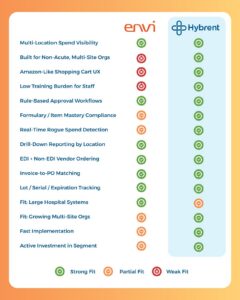
On paper, the feature lists look similar. The real differentiation shows up in implementation, usability, and how each platform actually behaves once you’re running dozens of locations through it day to day.
Where the Platforms Diverge
1. Built for the Segment vs. Built for One Segment
Envi, from Inventory Optimization Solutions, has historically been positioned toward larger, more complex health systems and hospital-affiliated networks with dedicated supply chain staff to manage the platform. That depth comes with a tradeoff: more modules, more configuration, and a steeper learning curve for the people actually placing orders.
Hybrent was purpose-built for the multi-site, non-acute world: ambulatory surgery centers, physician groups, post-acute and senior living organizations. If your organization looks like this (dozens of smaller sites rather than a handful of large hospitals), the platform’s design center matches your reality instead of asking you to adapt a hospital-scale tool to a distributed clinic model.
Why it matters: a platform designed for your organization type adopts faster and needs less customization to reflect how your locations actually operate.
2. Ease of Adoption at the Location Level
The consistent theme in user feedback on Envi is that it’s comprehensive, and that comprehensiveness comes with real setup and training overhead. That’s a fair tradeoff for a large system with a dedicated materials management team. It’s a heavier lift for a growing multi-site organization where the person placing the order is a nurse, office manager, or clinic administrator, not a full-time procurement specialist.
Hybrent’s “Amazon-like” shopping cart interface is the recurring point in customer reviews: staff can be productive with minimal training because the ordering experience mirrors something they already know how to use. For organizations where procurement discipline breaks down at the location level (which is most of them), that lower barrier to adoption is what actually gets rogue spend under control. A sophisticated platform nobody wants to use just pushes staff back to email and phone orders.
Why it matters: the best compliance control is a system your staff actually prefers over the workaround.
3. Visibility and Control Across the Org
Both platforms report on spend. The difference is how actionable that reporting is at the level you’re being asked to manage.
Hybrent’s reporting is built around the questions multi-location leaders are actually asked to answer: spend by location, spend by group, contract compliance, and where rogue spending is happening, with drill-down from the enterprise view to the individual site. Combined with rule-based approval workflows and a controlled item master with preferred vendors and formulary items, it’s designed to stop off-catalog and off-contract purchases before they happen, not just report on them after the fact.
Why it matters: if you can’t see rogue spend in real time, by the time the report tells you about it, the money’s already gone.
4. A Platform Still Investing in the Non-Acute, Multi-Site Model
Envi has been a stable player in this space for two decades, largely serving larger, more established systems. Hybrent, now part of Procurement Partners and backed by Serent Capital, is squarely focused on continued investment in the segment it was built for: growing multi-site healthcare organizations that need enterprise-level control without enterprise-level complexity.
Why it matters: you’re not just buying software, you’re picking a vendor who needs to keep building for organizations like yours specifically.
The Bottom Line
If you’re running a large hospital-affiliated system with a dedicated materials management team and the bandwidth to manage a more complex platform, Envi is a proven, established option.
If you’re managing procurement and inventory across a growing number of ambulatory, physician, or post-acute sites, and your real problem is getting consistent adoption, real-time visibility, and control over how to prevent rogue spend in procurement without a full-time administrator per location, Hybrent is built specifically for that problem. The lower adoption barrier, location-level reporting, and approval controls are designed to close the gap between “we have a procurement policy” and “our policy is actually followed.”
Next step: if multi-location spend visibility and staff adoption are your two biggest blockers right now, it’s worth requesting a demo focused specifically on those, not just a feature walkthrough.
Frequently Asked Questions
What’s the main difference between Envi and Hybrent?
Envi is positioned toward larger, more complex hospital-affiliated health systems with dedicated supply chain staff. Hybrent was purpose-built for the multi-site, non-acute world, ambulatory surgery centers, physician groups, post-acute and senior living organizations, with a lower-training-burden shopping cart interface designed for staff who aren’t full-time procurement specialists.
What is rogue spend and how do procurement platforms prevent it?
Rogue spend (also called maverick or off-contract spend) happens when staff purchase outside approved vendors or contracted pricing, often because the approved process is harder to follow than going around it. Platforms prevent it by making the approved path the easiest one: guided catalogs, rule-based approvals, and real-time visibility into spend as it happens rather than after the fact.
Is Hybrent or Envi better for a growing multi-site organization?
For organizations with a growing number of smaller sites, ambulatory surgery centers, physician groups, or post-acute and senior living communities, Hybrent’s design center matches that reality more closely than a platform built primarily for large hospital systems.
How long does it take staff to learn Hybrent versus Envi?
User feedback consistently describes Hybrent’s shopping-cart-style interface as requiring minimal training since it mirrors interfaces staff already know. Envi’s more comprehensive feature set comes with a correspondingly steeper learning curve, which tends to work better for organizations with a dedicated materials management team.
Looking to Reduce Your Annual Spend?
Procurement Partners helps healthcare organizations strengthen their supply chain operations while reducing annual spend by over 10%. As a leading healthcare supply chain software solution purpose-built for post-acute, non-acute, and continuum-of-care providers, the platform simplifies the procure-to-pay process. Users can place orders and process invoices for all suppliers through a centralized system. By automating procurement workflows, organizations report up to 40% time savings and 95% supplier contract compliance.
Request a Demo focused on multi-location spend visibility and staff adoption.