What separates procurement software that actually closes cost gaps from software that just digitizes the same old process.
Every healthcare organization says it wants to cut costs. Fewer say exactly where those costs are hiding. In post-acute, senior-living, and non-acute settings, the honest answer is usually the same: money leaks out through gaps in the purchasing process itself, not through any single bad decision. A missed contract discount here, a duplicate invoice there, a stockout that forces an emergency buy at full price. None of these show up as one big line item. They show up as a slow, steady drag on margin.
That’s the real test for any healthcare supply chain software purchase: does it actually close those specific gaps, or does it just move the same manual process onto a screen? The features below are the ones that make the difference, drawn from what centralized purchasing platforms like Procurement Partners’ OnCare and Hybrent are built to deliver.
Feature 1: An End-to-End Procure-to-Pay Workflow
The first gap to look for is fragmentation: separate tools or spreadsheets for requesting, ordering, receiving, and paying. Every handoff between those steps is a chance for a number to get re-typed wrong, a step to get skipped, or a purchase to slip outside contract pricing entirely.
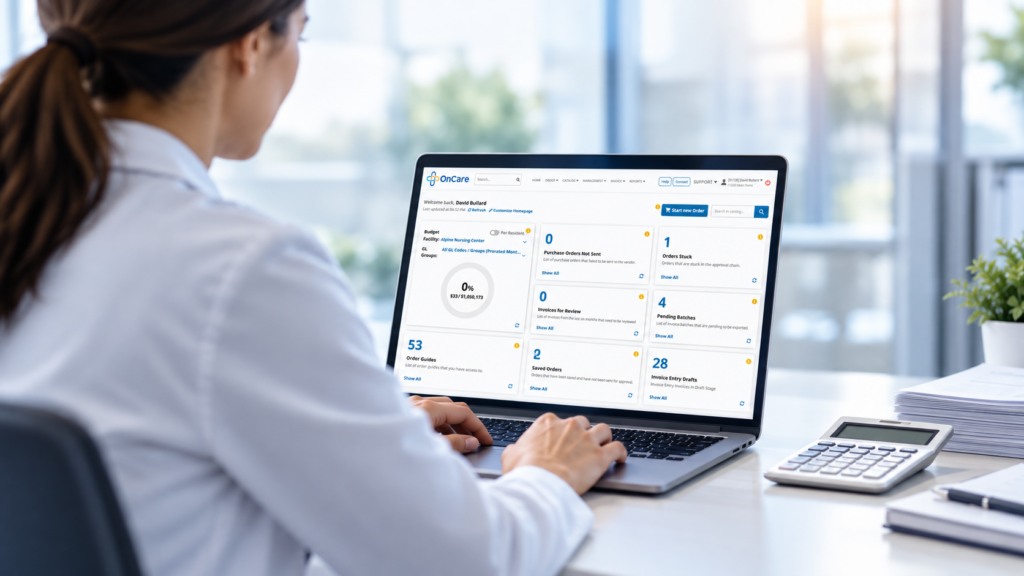
Software that connects the full procure-to-pay continuum in one place removes those handoffs. Organizations that move to a connected OnCare workflow with Procurement Partners report 40% time savings and 10%+ cost savings within months of go-live, largely because the re-keying and off-contract “maverick spend” that used to slip through simply has nowhere to hide anymore.
Feature 2: Built-In AP Automation, Not a Bolt-On
Manual invoice processing runs 40–90% more expensive than automated processing, and that gap alone is often enough to justify a system change on its own. But the feature to actually look for is three-way matching that happens automatically, invoice against PO against receipt, with OCR capture so nobody’s keying line items by hand. Bills should post cleanly to your GL without a manual export step in between.
Feature 3: Spend Analytics That Surface Problems Before They Compound
Most procurement reporting looks backward: here’s what we spent last month. The more useful version looks for patterns across thousands of transaction lines, flagging spend analytics insights a person would take weeks to notice manually. That’s the difference between catching a pricing problem after one bad quarter versus after one bad month.
Feature 4: Contract Compliance Enforcement, Not Just Contract Storage
Plenty of systems store your contracts. Fewer actually check every purchase against them in real time. Look for automated price-checking against contract files and alerts the moment a price drifts from what’s negotiated. Procurement Partners customers see 95% supplier-contract compliance this way, capturing GPO-negotiated discounts that would otherwise get missed at the point of purchase, not caught after the fact in an audit.
Feature 5: Inventory Data Connected to Purchasing, Not Sitting Beside It
The fifth gap is the physical one: inventory that’s tracked separately from what gets ordered. When PAR levels and on-hand value live in the same Hybrent system as purchasing, dashboards can show expiry risk and stockout risk side by side, so orders get right-sized instead of padded “just in case.” That single source of truth is what lets finance, nursing, and supply-chain leaders work from the same numbers instead of reconciling three different spreadsheets.
How to Evaluate Procurement Software: A 5-Point Checklist
Before comparing vendors, it helps to know exactly what you’re trying to fix. Use this as a working checklist during evaluation:
- Map your current gaps first. List every manual touchpoint from requisition to payment before you look at a single demo.
- Ask where the bottleneck actually is. PO creation, approvals, invoice matching, or reporting: pick the one costing you the most time today.
- Request a pilot, not just a demo. One facility, measurable KPIs (cycle time, late fees, off-contract spend), before you commit organization-wide.
- Confirm it scales without re-implementation. Cloud architecture should let you onboard new sites without rebuilding the setup each time.
- Check what happens after go-live. Good software should support ongoing monthly reviews of spend dashboards and alerts, not just a one-time setup.
Where This Leaves Cost Reduction
None of these five features work in isolation, and that’s the point. Cutting costs without cutting care depends on closing several small gaps at once rather than finding one big fix. Procurement Partners helps 1,000+ healthcare providers do exactly that, often reducing annual spend by more than 10% in the first year, by giving every one of these five features a home in one connected platform instead of five separate tools.
Book a demo to see how Procurement Partners can transform your supply chain, so your clinicians can focus on what matters most: delivering exceptional care.
Frequently Asked Questions
What features should I look for in healthcare procurement software?
Look for an end-to-end procure-to-pay workflow, built-in AP automation with automatic three-way matching, spend analytics that surface patterns proactively, real-time contract compliance checking, and inventory data connected directly to purchasing rather than tracked separately.
How do I choose the right procurement automation software for a healthcare organization?
Start by mapping your current manual touchpoints and identifying your biggest bottleneck, whether that’s PO creation, approvals, invoice matching, or reporting. Then pilot the software in one facility with measurable KPIs before committing to an organization-wide rollout.
How much more does manual invoice processing cost compared to automated processing?
Manual invoice processing typically costs 40–90% more than automated processing, largely due to data entry time, missed early-pay discounts, and errors that require rework.
Can procurement software reduce costs without affecting care quality?
Yes — the biggest cost gaps in healthcare procurement (off-contract purchasing, invoice errors, inventory waste) are administrative, not clinical. Closing them through better software doesn’t require reducing supplies or care standards.